

Google Customer Rating of 4.9 Out of 5

Recognized by WHO for active AFP reporting


Tongue Paralysis can occur due to nerve, muscle, or brain disorders making it difficult to control the movement of the tongue, mouth, or laryngeal muscles. This condition is also known as Dysarthria. These muscles could become completely paralyzed or weak temporarily, depending on what is causing it.
If the underlying cause is treatable, tongue paralysis can be cured completely with proper medication, and speech therapy.
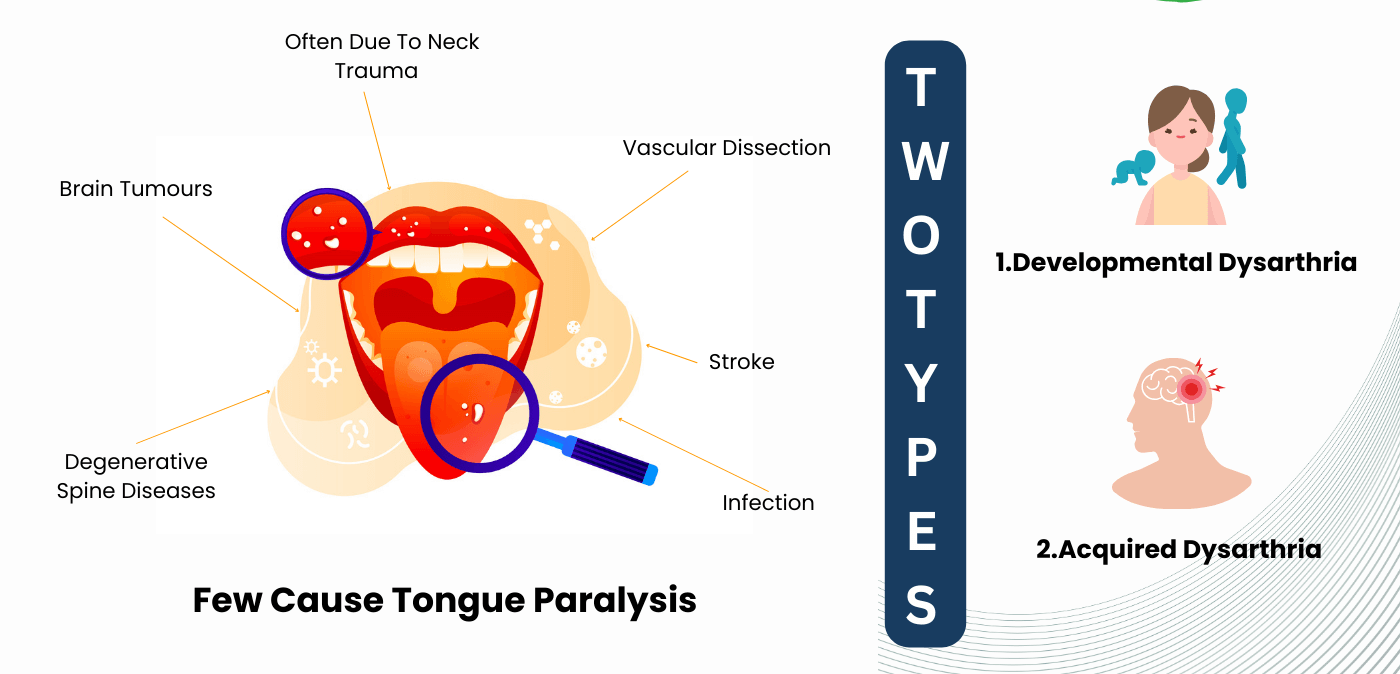
Tongue Paralysis is when throat, tongue, or laryngeal muscles become weak or paralyzed due to various neuromotor, nervous system, or brain conditions. The damage can make it difficult to control your voice or tongue, leading to slurred speech.
Few medicines may also cause dysarthria.
Extremely rarely, hypoglossal nerve palsy may also cause tongue paralysis, often due to neck trauma, brain tumours, degenerative spine diseases, stroke, infection, vascular dissection, etc.
Dysarthria can happen of two types:
People with tongue paralysis can understand speech but have minor to severe trouble in speaking.
Based on the underlying cause, tongue paralysis may occur suddenly or develop over time. The main signs and symptoms are as follows:
It may occur due to several neuromotor, brain, or central nervous system disorders, either inborn or acquired. These conditions can be grouped as follows:
Your doctor will study your medical history and evaluate your signs and symptoms. Depending upon how severe your condition is, they will examine your speech, movement of the tongue, and voice control. Further tests such as CT/MRI scans, EEG, EMG, etc. may be required to diagnose tongue paralysis.
Homeopathy takes a holistic approach to tongue paralysis treatment by preventing further worsening of the condition and controlling the symptoms. Early diagnosis certainly helps with complete or partial loss of muscle movement, when paired with speech therapy to improve speech and swallowing.
Homeopathy medication, rehabilitation, and occupational therapy are often effective in tongue paralysis treatment. The medicines help regulate blood flow, heal damaged areas, and regain muscle strength. Also, homeopathic treatment is completely safe with generally no side effects, making it suitable for patients of all ages.

Since various reasons can cause tongue paralysis, you cannot always prevent it. However, you can take measures to reduce risk factors such as stroke or trauma.
These measures include:
Depending on the causes, if it is caused due to medication side effects or toxicity, it can be reversed. However, if it is due to a chronic condition such as stroke or trauma, it may not go away completely. Still, your speech may improve with speech therapy and consistent homeopathy medication.
If it gets difficult to swallow, chew, or speak, seek immediate medical attention. See a doctor if you have unexplained or sudden weakness or numbness in your tongue.
Tongue Paralysis is a serious condition that can occur due to damage to the muscles that control your tongue or voice box. Since you cannot understand what is causing the problem, it is wise to consult an expert healthcare provider who can properly examine your case, learn your symptoms, and make a diagnosis.
If you witness any of the symptoms listed above, you can book an Online Consultation with our Expert Homeopathic doctor via Call or Video Call for further assistance.


When i start to speek after few minutes i feel a pain and stiffness in middle of my toung and upper throat area, and my voice became low and i feel some strain and pain, and feel a lot of thrust, frequently i drink water please advice me
It sounds like you might have vocal strain or an underlying issue that needs attention. Homeopathy has effective remedies for throat stiffness, pain, and voice strain.
Namaste 🙏 sir. Ji
Mere mummy ko muh ke or jibh ke under lakwa mar raha he roz.
Kuchh samadhan bataye
Namaste 🙏
Aapki mummy ki takleef samajh sakta hoon. Homeopathy mein iske liye ache aur safe upay hain, jo unki halat aur wajah ko dekh kar diye ja sakte hain. Behtar hoga agar aap ek baar proper consultation lein, taki unhe sahi ilaj mil sake. Jaldi ilaj shuru karna zaroori hai. Aap chahein toh mujhe direct contact kar sakte hain. 🙏
Good morning, Dr.
My wife suffering from tongue stiffness and problem in talking and reading. We went through many diagnosis with different Doctors such as Neurology.
After MRI and many tests they said there is no problem in brain or nerves.
But she feels stiffness and below tongue discomfort and can pronounce words while reading and talking.
Kindly, pls advise, as we are from Mangalore it is difficult to visit your clinic.
Thanking you in anticipation
Good morning 🙏
Thanks for sharing the details. I understand your concern — tongue stiffness and speech issues can be very uncomfortable.
Don’t worry, such cases often respond well to homeopathic treatment after understanding the full case history. You don’t need to travel; we can arrange an online consultation to study her symptoms in detail and start the right treatment.
Please message or call us on WhatsApp to book the consultation — I’ll personally guide you through the next steps.
meri dasi ko bhi jibh ka lkwa h vo kuch kha bhi nhi skti muski se khati h kmjor ho rhi h koi solution btaye k vo thik se khaye or healthy ho jaue plz say some solutions ty
Bilkul, aapki daasi ki takleef samajh sakta hoon. Homeopathy mein iske liye achhe aur safe treatments hain jo jeebh ke lakve ko theek karne mein madad kar sakte hain. Sahi ilaaj se unki khaane ki takleef door ho sakti hai aur health bhi sudhar sakti hai.
I got my tooth extracted. It was the wisdom tooth growing inward. Since then a small part of my tongue hsd got paralysed. I have taken multivitamins but it has not helped. It has been 6 years now. Can I do anything about it
Hi! Sorry to hear you’ve been dealing with this for so long. Sometimes, nerve-related issues after tooth extraction can linger, but with the right approach, there’s still hope. Homeopathy has helped many in similar cases by gently stimulating nerve healing.
My sister has a stroke for over 2 years and this affected her speech. She often feels like she’s having catarrh and have difficulty swallowing.
Please Dr. what’s your suggestion on this and possible medication that she can use?
I’m sorry to hear about your sister. Speech and swallowing issues after a stroke are quite common, and homeopathy can definitely help in improving these symptoms gently and naturally. But for the right treatment, I’d need a bit more detail about her condition and medical history. I suggest booking a consultation so I can understand her case better and suggest the most suitable medicines. Early support can make a big difference.